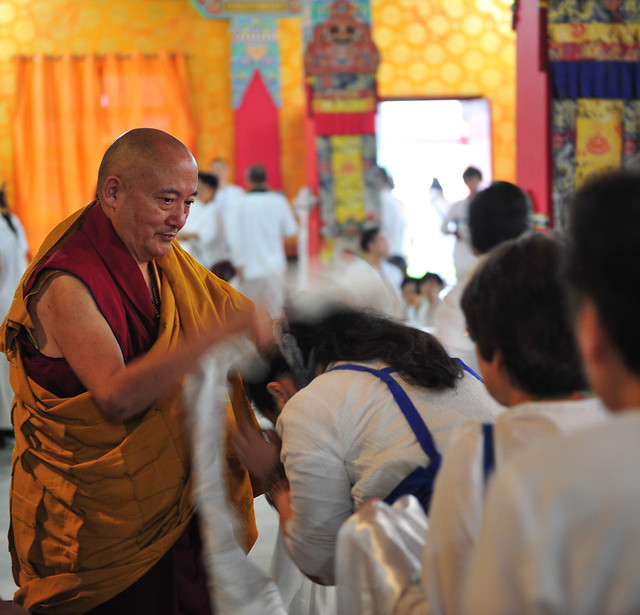
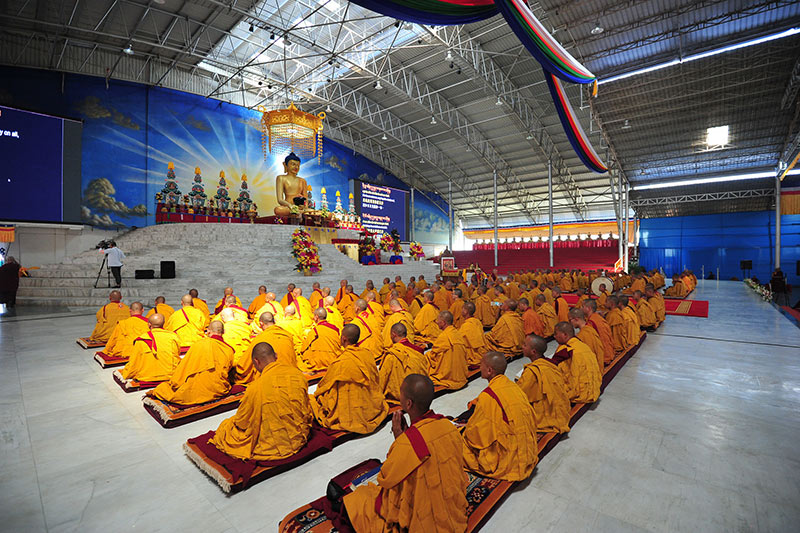
They are the ones without whom the Kagyu Monlam might not happen, or at least, not happen as smoothly as we usually take for granted it will. They help with everything from cleaning and bowl washing to kitchen duty and alms distribution. They are there as seating wardens, technicians, translators, photographers and reporters. They are the Gurusevakas - “those who offer their service to the Teacher,” in Sanskrit - around 300 of them during this 35th Kagyu Monlam.
They are not the only ones, but the Gurusevakas are special in that they are all truly volunteers, giving of their time and energy in order to help the accomplishment, year after year, of the great tent of auspiciousness that is the Kagyu Monlam. They do get one sure moment of limelight, when they meet in audience with the Karmapa (and, this year, with Gyaltsap Rinpoche) halfway through the Monlam.
Their work goes on all day long, and for some of the teams - for instance, those making the arrangements on the stage and around it for the next day’s events - sometimes into the wee hours of the morning, too. Indeed, the Karmapa, in his video message to the Gurusevakas during this year's audience, praised them for the hard work they had been putting in day and night.
Coordinating their work are the team leaders, who together with other senior volunteers and the khenpos, Rinpoches and principal teachers, make up the Working Team. They communicate directly with the Karmapa, receive his instructions, and report on the facts on the ground. The Working Team is made up of only around 70 people, but they have all been working with the Karmapa for a long time.
Yet another category of “service offerers” in the Kagyu Monlam, who operate quite separately from the Gurusevakas, are the Dharmapalas - “the protectors of the Teachings” in Sanskrit. This is a term perhaps more familiar to students of Vajrayana as designating a class of powerful beings subjugated into offering aid and protection to Buddhism and Buddhists. The Dharmapalas in the Kagyu Monlam do fulfill a similar role, being in charge of security, most visibly at the screening facilities at the entrance to the Kagyu Monlam Complex, but inside the Complex as well.
The Dharmapalas, around 60-70 of them, are universally amiable, like the personable Gonpo Tseten, on duty this afternoon. The feeling of gratitude he expresses for all the experiences the Kagyu Monlam is offering is shared by all the Dharmapalas:
We feel very special to be working under His Holiness the Gyalwang Karmapa.We feel his blessing. We get to meet so many different people, from so many different countries. It's a great opportunity for us.
All the Dharmapalas come from Suja Tibetan Children's Village School in Dharamshala. The TCV schools were originally established by the Dalai Lama's sister after their flight from Tibet, when she noticed the high mortality rates amongst children in the refugee camps.
Both Gurusevakas and Dharmapalas are drawn from a variety of cultures and languages. The English-speaking reporter trying to build a picture of the Gurusevakas must therefore do with snatches at best: the Indian volunteer accountant whose wife is a Tibetan Buddhist and brought him to the Monlam; the Tibetan helper at the lunch service who has been doing it for 10 years and says the best part is getting to meet the Rinpoches and the Karmapa; the Spanish translators who have been practising Buddhism for 30 years in Huéscar and have finally found the motivation to come and make the personal connection to the Karmapa; the third-timer Dutch lady directing the queue for Gyaltsap Rinpoche’s audience in stunning fusion fashion, combining her sari with a Tibetan jacket.
And that’s without mentioning the volunteers in other Kagyu Monlam projects happening at the same time, such as the Well-Being Free Medical Camp. Akila from Gangtok is one such, and we leave the last word on service to her. When asked about her motivation to volunteer, she immediately said, her connection as a Kagyupa:
Helping people makes my inner soul happy. And I believe that serving is as much part of the Kagyu Monlam as praying.
For Members of the Friends of Kagyu Monlam, the mad dash to the Mahayana Hotel at the end of every morning session, with every rickshaw in sight snapped up and piled high for conveyance to the Members’ buffet lunch, is now a thing of the past. Brand new dining halls for Friends and Special Guests are available in a vast white building—the Kagyu Monlam Kitchen and Dining Halls, festooned these spring days with prayer flags even more colourful than usual—behind the Pavilion, occupying the floors above the huge ground-floor kitchen which caters for Sangha and laypeople.
The new dining halls were inaugurated by Gyaltsap Rinpoche and Datin Sri Loo Choo Ting from Malaysia, one of the most generous sponsors of the Kagyu Monlam, and also a sponsor of the Medical Camp. They were accompanied by Yongey Mingyur Rinpoche, Adzin Rinpoche, Drupon Dechen Rinpoche, and Lama Choedrak, the CEO of Kagyu Monlam.
For the first lunch of the 35th Kagyu Monlam on February 26, Friends formed an orderly queue all along the stairs to the second floor, where their dedicated dining hall is located. Most of the Sangha converged towards the large window counters on the ground floor, and had their lunch, once served, in the marquee next door. Some others, both Sangha and lay practitioners, were invited into the Special Guest Dining Hall on the first floor, where a Taiwanese kitchen team is in charge.
The new Friends’ Dining Hall, painted light yellow, with windows on every wall and ceiling fans, was blessedly cool in the already warm North Indian spring. And spacious: even with Friends pouring in from the staircase, once everybody was served and seated, it still had capacity to spare. But if this were not enough, the Kagyu Monlam Kitchen and Dining Halls also has room for expansion onto the third floor, directly under the tin roof.
The new dining halls seat six to a table, on comfy, sturdy, plastic chairs in red and black. In the Friends' Dining Hall, a trio of thangkas across from the entrance depicts the founding Tibetan masters of the Kagyu lineage: Milarepa, Marpa and Gampopa. Another thangka on the northwestern wall features the Four Harmonious Animals (an elephant, a monkey, a hare and a bird under a fruit tree), a popular theme in Tibet and Bhutan.
One can imagine that the Monlam kitchen staff may have had first-lunch jitters in their new premises, but in the Friends’ experience so far, the buffet was as plentiful, and as plentifully replenished, as in its Mahayana Hotel days.
Indeed a visit to the ground-floor kitchen shows that it is a facility that never sleeps. In between meals they are busy with the drinks breaks, and the enormous scale of the preparations can be seen in the gigantic pots and pans, and the piles upon piles of supplies.
In the final session of his four-day teaching, His Holiness the 17th Karmapa concluded his commentary on Geshe Potowa’s Long Soliloquy. He resumed the text from “I’ve gained what is most difficult to get…” a quote from Shantideva’s Bodhisattva’s Way of Life which refers to the leisures and resources of the precious human body. Emphasising the importance of a thorough contemplation of the Four Common Preliminaries, His Holiness explained that this establishes the foundation on which all further spiritual practice is built:
When we teach the Four Thoughts that Turn the Mind, we give instructions on death and impermanence, the precious human body, karmic cause and effect and the defects of samsara. We teach all four of these, but when we teach them, even though these preliminary dharmas are like the foundation, we don’t give them much importance. Many people don’t know they are crucial. But, when we talk about mahāmudrā and Dzogchen, everyone thinks that those are really important and significant. However, in actuality, it is as is said: the preliminaries are more important than the main practice. If we cannot lay a good foundation with the preliminary dharmas, then it will be difficult for the dharma of the main practice to bring great benefit to your mind. As the Kadampa masters of the past said, “If you do not develop the realization of Death and impermanence in your being, Guhyasamaja will not be profound. But if you do develop Death and impermanence in your being, the three lines of refuge are profound.”
Geshe Potowa’s text continues: They don’t even seek the Dharma. They hope for the merit of the Dharma from their knowledge of the profane.
This, the Karmapa explained, is an indictment of those who seek merit but do not seek the dharma. The merit they want is that of the eight worldly concerns, the good things of mundane life, such as wealth or fame, not the accumulation of merit within the practice of dharma. The Karmapa commented:
Seeking worldly merit and seeking the true dharma do not mesh. This is because one is seeking good in this life and the other is seeking good in future lives. For this reason, they are contradictory to each other. They oppose each other… if in your mind, you harbor the clinging, or the great desire, of wondering whether you will be prosperous in this life or have abundance in this life, it will be difficult to gather the accumulations and purify the obscurations well…
Usually, when we talk about the two accumulations, there are the accumulations of merit and the accumulations of wisdom. But before we can perfect the accumulation of wisdom, we must first perfect the accumulation of merit. And in order to perfect the accumulation of merit, we need to put the eight worldly concerns of this life completely out of mind. We must give up on the eight worldly concerns of this life, or the mind that clings to the goodness and prosperity of this life. We must not be attached to any of the good things of this life. So then from the time that we develop a pure mind of non-attachment, whichever of the ten transcendences we might train in, we might be able to gain some freedom, or gain some control or independence in our practice.
Non-attachment is the very beginning of the path for the dharma practitioner and it is for this reason that Geshe Potowa repeats the phrase “It is important to give up on this life” three times. Whether we are practicing profane or sacred dharma—profane, worldly dharma or the sacred True Dharma—is determined only by this, the Karmapa reflected. Potowa is quite clear that if we do not give up on this life, we are not a true dharma practitioner.
Sadly, according to Potowa, it seems as if becoming a monastic makes the situation worse rather than better. The text reads: Before we start to practice Dharma, none of us practitioners have much attachment to wealth and things, and we seldom yearn for those close to us. We do not want to pay attention to work or tasks. But once someone enters the Dharma, they make profane ambitions the most important.
His Holiness elaborated with a contemporary example of two brothers:
One enters the gate of dharma and takes monastic vows. The other doesn’t and does worldly work instead. But the one who became a monastic and lives in the monastery becomes the one who “makes profane ambitions,” who makes the worldliest plans for this life, and the one who always gives the most advice and help. They show up everywhere. If there is some worldly task that needs one to go into detail, they say, “You should give this much. You should give them that thing but not that. You should give this or that. Even if they don’t know how to do anything else, at the very least, they’ll pass messages back and forth about work or news. And if someone needs to be sent as a representative, to make a connection, to make a contact and so forth, it’s always them who are the one to do it.
So, ultimately, the monastic has more experience of and knows more about worldly affairs than his brother the householder! At the root of this confusion, Geshe Potowa points out, lies the failure to remember that they will die: When made to practice the Dharma, what they think of is riches. They only do what they are not forced to do. This is because of not remembering death.
Continuing with his commentary, the Karmapa explained that if we truly practice dharma the evidence will be there in our lives for others to see:
If we are able to practice true dharma, even our enemies—like our real antagonists, people who dislike us from the core of their beings, the true enemies—even they will begin to think, “Oh that’s a real dharma practitioner.” They’ll think, “Oh that’s a really good person.” Even they, in their own minds, will begin to see us as an agreeable person.
It’s like Milarepa, for example. Milarepa did sorcery, killing his aunt and uncle’s children and many relatives. But at the very end of it all, his aunt came to the thought, “Oh Milarepa really is a true dharma practitioner. He’s actually a good person.”
Geshe Potowa elicits the benefits of practising the pure dharma sincerely as: receiving the blessings of the buddhas and bodhisattvas; fulfilling the intentions and wishes of the gurus and spiritual friends and pleasing them; being helped and supported by the gods and dharma protectors in whatever task or activity we are doing.
“May my mind become the dharma,” His Holiness quoted, from the Four Dharmas of Gampopa. In order to achieve this, he continued, we need to develop the realisation of death and impermanence in our beings and revulsion towards this life. Only if this could happen, would our minds become the dharma.
Usually, when talking about the paths of the three types of individual, we talk about the path of the lesser type of individual, who, out of fear of the lower realms, seeks the pleasures of the higher realms in the next life. At the very least, we absolutely must be someone who thinks about our next and future lives. And if that occurs, only then can we be included or counted as a dharma practitioner.
Our mind needs to be free of any clinging to this life, otherwise our mind will not become the dharma.
Geshe Potowa’s text now reminds the reader that there is no escaping death and that:
When we are stricken with a fatal illness and know we will not escape, it is too late to say, “I am not destined to die like this. I have something better to do than this. If this old ghost doesn’t die, I really will genuinely practice the Dharma. We are wandering in samsara but have the opportunity to awaken to buddhahood. This brief life will definitely run out. Therefore we must give up on this life and genuinely practice the Dharma.
We should practice the dharma now while we have the opportunity, and not procrastinate. Dharma practitioners should have no regret at the time of death, knowing that they have used their precious human life meaningfully, the Karmapa commented.
Geshe Potowa frequently draws our attention to death and impermanence, because, based on his own experience, he knows the value of contemplating them. It is far more than generating a fear of death. Rather, it is realising that we will die, acknowledging that we do not know when we will die, and consequently seizing the time now to make our lives meaningful, to accomplish whatever our goal in life is. At a more subtle level, it is the realisation that all compounded phenomena change and die, and that this process is happening moment-by-moment, now. Nothing stays the same. Our human life too changes moment-by- moment. “For that reason, in every minute, every hour, every day, every week, every month we always get a new chance. We are always getting new chances. As we get each new chance, we must not let those opportunities go to waste,” His Holiness urged.
From one perspective, in the past in this life, we have had faults, we have made mistakes, we have not fulfilled our wishes, but that is all in the past. But now, a moment later, an hour later, we get a new chance. Because we do get a new chance, it is important that we clearly recognize that new opportunity, and then use it to make ourselves into a new person and give birth to a new human life. It is important for us to develop this new prajna, this new understanding. If we can do that, only then will we feel the great benefits or the great power that comes from meditating on death and impermanence. This is the reason why Geshe Potowa reminds us repeatedly that meditating on death and impermanence is important.
Finally, the text concludes:
Even though I do not think it will help anyone else, I could not help but say this to myself. If this was not from the heart, punish me.
This was Guru Potowa’s Long Soliloquy, the ultimate evidence of practicing the Dharma.
His Holiness suggested two ways of looking at this final sentence. From one perspective it reflects Potowa’s own practice of continuous self-examination, but from another, Geshe Potowa calls it a soliloquy because he knows no one else will listen to what he has to say. As the Karmapa pointed out, “Very few people are interested in developing the realization of death and impermanence in their hearts, and so for that reason, this illustrates how his heart became very heavy and he became depressed.”
In closing, the Karmapa expressed his happiness that in spite of his absence from the 35th Kagyu Monlam, he was able to “make a profound dharma connection through modern technology”, and then dedicated the virtue from the teaching:
By the power of the virtue from this teaching, may all sentient beings throughout space progress down the path from happiness to happiness, and may the precious teachings of the completely perfect Bhagavan Buddha flourish without ever waning. May the great beings who uphold the teachings, in particular, the Dalai Lama who is like the eye and heart of all Tibetans, live long and may all his activities be spontaneously fulfilled. May all great beings in all the dharma lineages, as illustrated by the four great lineages of Tibetan Buddhism, may all these great beings live long and be harmonious. In particular, may the teachings of the Dakpo Kagyu flourish and may the Karma Kamtsang lineage, founded by the glorious Dusum Khyenpa, thrive and flourish a long time. May all the communities of the Sangha have pure discipline and be harmonious.
In particular, may all sentient beings with whom we have connections be cared for lovingly and compassionately by the buddhas and bodhisattvas in the short term as well as in the long term, and may they swiftly achieve the state of liberation and omniscience. This is the dedication I am making, and I’d like to ask that all of you, the entire sangha, offer your support and assistance, by making the same aspiration.
His Holiness had not been physically present, yet to those watching and listening in the Monlam Pavillion, it felt as if he were present, and the directness and power in the teachings he gave were unaffected by the distance.
Having greeted the Rinpoches, monastics, and lay students, His Holiness continued teaching on the Long Soliloquy from the section which emphasized the temporariness of this present life, feeling revulsion towards samsara, and the compulsion to practice the Dharma immediately.
Compared to Future Lives, the Present Life is Temporary One of the crucial points of the first passage His Holiness read is to avoid imprudent advice that misguides the Dharma practitioner. Geshe Potowa says,
Now is the time to look for a good guru, but some say, ‘What good will going to see a guru do? It would be better to fake meditating.’ Many people talk like that. You need to gather incalculable accumulations to meet a good guru, so what good will it do to not look now and instead keep faking it? If you meet a good guru, you will develop samadhi through the guru’s blessings. Because of that, you will realize your mind and awaken to buddhahood. But some would rather not be criticized than awaken to buddhahood.
Geshe Potowa encourages us : not to see who is the most ambitious, who the most assertive, and who is the biggest swindler but to see how to direct the mind towards the Dharma. Furthermore, there are some who only say the spiritual master is compassionate if he gives something material and criticize anyone looking for a guru and pith instructions.
His Holiness explicated the meaning of this passage underscoring that some say they are willing to help care for things in this life, but there are very few who will support or provide for your future lives. He said, “Actually, compared to future lives, the present life in terms of time is just temporary. When we talk about the life after this, and the life after that, there is no end.” Understanding this is extremely important, but also rare.
I’m Definitely Going to Die Continuing with the text, the following verses remind us that knowing we will have to leave everything behind is not a far-fetched tale: Yet, those who are clever, assertive, and ambitious do not sense this. His Holiness summarized that we cannot take life’s pleasures along with us when we die. As he said:
If you know how to be content, even if you are a disabled beggar whose hands and feet have been amputated living in the rough by the side of the road, you can still bear life; you can still handle it. Basically, no matter how much power and wealth you have, in the end of it all, it will be like drawing a hair out of butter. You will have to go on alone; there is no way to take along any of your wealth, possessions, or power.
His Holiness gave the example of someone with a serious illness trying to avoid death. Even they do not have the intense feeling, “I will die; I’m definitely going to die.” Even more, we work hard right now so as not to have many challenges when we are old. When we are old, we physically deteriorate and are unhappy until we die. But then, our future lives will be exactly the same. “For this reason,” His Holiness emphasized, “if we spend our entire lives only working towards our ambitions for this life, working for the sake of this life from the time we are young on, we will not be happy in our next life.”
Our Mind Should Be Comfortable at the Time of Death Geshe Potowa’s verses elaborate upon the thoughts of this life such as, “Today I’ll do this. Tomorrow, I’ll do that. Next year, I’ll do this. I’ll do that when I’m old.” But, he says, “Practitioners should do the opposite and not include immortality in their discussions. Then you can make preparations for death.” He reiterates these points because at the time we leave this life behind, we should be comfortable at the time of death.
His Holiness commented that some think there is no point in saying, “I’m going to die.” It just scares you.” But, as Dharma practitioners, we should prepare for our death by doing the things that will help us as we are dying. He further emphasized that, “We should be saying, ‘I’m going to die. I don’t know when I’ll die. I don’t know what will be the cause of my death.’” Thinking this way will help prepare us to have confidence and comfort in mind when we die. Otherwise, “If that does not occur,” he said, “you may have spent your entire life practicing dharma, but if we do not feel comfortable and satisfied when we get to the time of death, it will not have been much benefit.”
A Monastic is Someone Who is Revolted by Samsara Turning back to the text, His Holiness read,
Merely not getting married does not help. You must turn your back on the eight worldly concerns. Gathering merit means that your mind becomes the Dharma, not that you are well-respected or have good clothes. You might be sick with leprosy, blind with your hands and feet amputated, your clothes so badly tattered no one could take hold of them, but if your mind becomes Dharma, that is called accumulating merit.
His Holiness commented that the first line of this passage is a reminder that, “a monastic is someone who should be revolted by samsara and who has the intention to be emancipated from samsara.” He explained that in Karma Chakme’s Mountain Dharma, it says that Tibetans only have one vow – if a monk does not meet his wife, then his vows are pure. However, His Holiness asserted that, “You can’t say that just not getting married makes you a monastic” for this is not what is actually said in the Vinaya. “For the monastics,” he said, “there are the four root precepts or four defeats: killing, taking that which is not given, sexual activity, and lying about supreme human qualities.” He encouragingly said, “If you know the Vinaya well, keeping the vows well is not all that difficult.” This is because the Buddha has great compassion and does not force anyone. So, if a monastic encounters real difficulty where the vows cannot be kept, it is possible to give back the vows by telling a qualified person. If this is done and one wishes to take the precepts again in the future, you may. Whereas, if someone has difficulties and loses the vows, in the future, they cannot be truly received even if the motivation exists to take them again.
Set Out on the Path and Go His Holiness stressed that the next passage centers on, “No matter what practice you are doing, it is to be done today.” As the Long Soliloquy says,
To say you understand the Dharma is to say that you know the methods to achieve Buddhahood. The words are not the point. Instead of saying you have knowledge of the path, it is better to set out on the path and go. If you do not start practicing right now, you may think that you will meditate after you have made all your preparations, but that time will never come. You will use up your whole life preparing.
His Holiness clarified that there is a distinction between knowing and understanding the Dharma:
The reason they are different is that if you really know the Vinaya and understand it as it should be understood, you will be able to practice it. In order to understand it, you need to know it – you can’t understand something you don’t know. But there are many things we know but don’t understand…. it’s better to actually set out on the path and go.
He also reminded us that we tell ourselves that we are going to practice, but then stall because we need to make preparations. But, then it is possible to spend your whole life getting ready. He poignantly said, “You need to develop understanding of it within your being. When you develop that understanding of the meaning in your being, then you will be able to put it into practice.”
Abandoning the Afflictions Returning to the text, His Holiness read: Some say that tantra and the Vinaya are exclusive of each other, but they have misunderstood. His Holiness explained that, “This is a question of not really understanding it.” Because as Geshe Potowa says: If something occurs that is an inappropriate basis for the mantra, it is not the Vinaya. If something occurs that violates the Vinaya, it is a sign of it not being the secret mantra.
The analogy used is planting a field. Sometime it needs to be irrigated, sometimes it needs to be ploughed with oxen. By piling on all these efforts there will be good crops. “Likewise,” His Holiness said, “whatever practice we do, whether tantra or vinaya, it all needs to be piled on top of the afflictions…there is no practice for which we don’t need to put this life out of mind. There is not practice that doesn’t involve abandoning the afflictions.”
Geshe Potowa poses two questions: What good is a teacher learned in Dharma that is not an antidote for the five poisons? What can cure an illness that cannot be remedied by medicine? In response, His Holiness explained that, “Sometimes there are geshes and khenpos who know a lot of Dharma and like to talk...but, their motivation has been crooked from the beginning.” Or, maybe becoming famous is their aim. His Holiness said that, “For such individuals, such geshes and khenpos, there’s no liberation from samsara.”
Turning to the second question, “No matter what Dharma we practice,” His Holiness continued, “it must act as an antidote for suffering. If you don’t make it an antidote for the suffering, being learned about the dharma and being able to explain it to people does not help. Actually, Dharma is medicine for curing the illness of the afflictions.” If we are resistant to the the medicine of Dharma, “your mind stream will turn so wild that no one can handle it.” But, if the medicine of Dharma does not help your mind stream, what good is fame and renown? If you are to be reborn in the lower realms, fame does not follow you and neither does pretending to be venerable do you any favors. While you may fool some, “the Lord of Death has a mirror, and whatever the situation, whether it is true or false will appear in it.” Most importantly, a true spiritual friend helps others turn away from committing and accumulating misdeeds. What is extremely rare are those meditators, good lamas, khenpos or geshes who “do whatever they can to help the students around them avoid misdeeds or sufferings and bring them to virtue.”
Finishing up reading the text for the day, His Holiness read the verses of Geshe Potowa,
Making this life most important and practicing the Dharma on the side will not work, but no one will listen. If you do not recall death, you will do whatever is most profitable in this life. You will even be able to violate your guru’s commands if they do not measure up to your ambitions. If it seems it will profit you in this life, you will pretend to be so faithful and so devoted to the guru. Deep down, this annoys me.
Summarizing briefly, His Holiness said the meaning of this passage is that when you make distinctions in your mind between your own and others, then, it is certain you have not developed bodhichitta. Further, committing misdeeds to protect your own is a wrong path for anyone.
A Connection Between Us As he concluded the day’s teachings, His Holiness relayed his own experience with giving the teachings this year. For him personally since he is only looking at the cameraman, it is different than previous years when he is actually at the Monlam. He said, “The feeling is different. But as much as I can, I am imagining that you are all there...In that way, I feel there is some sort of connection between us.” He continued, “When I teach this, even if we can’t all put this into practice right now, when I teach and you listen, it moves us somehow. In particular, it helps us see a lot of our faults.” As he said, one extremely important thing is to gain a degree of understanding, incorporate it into our mind streams again and again as we make efforts to change ourselves. And, if we can do this, there will be the great benefit of the Dharma.
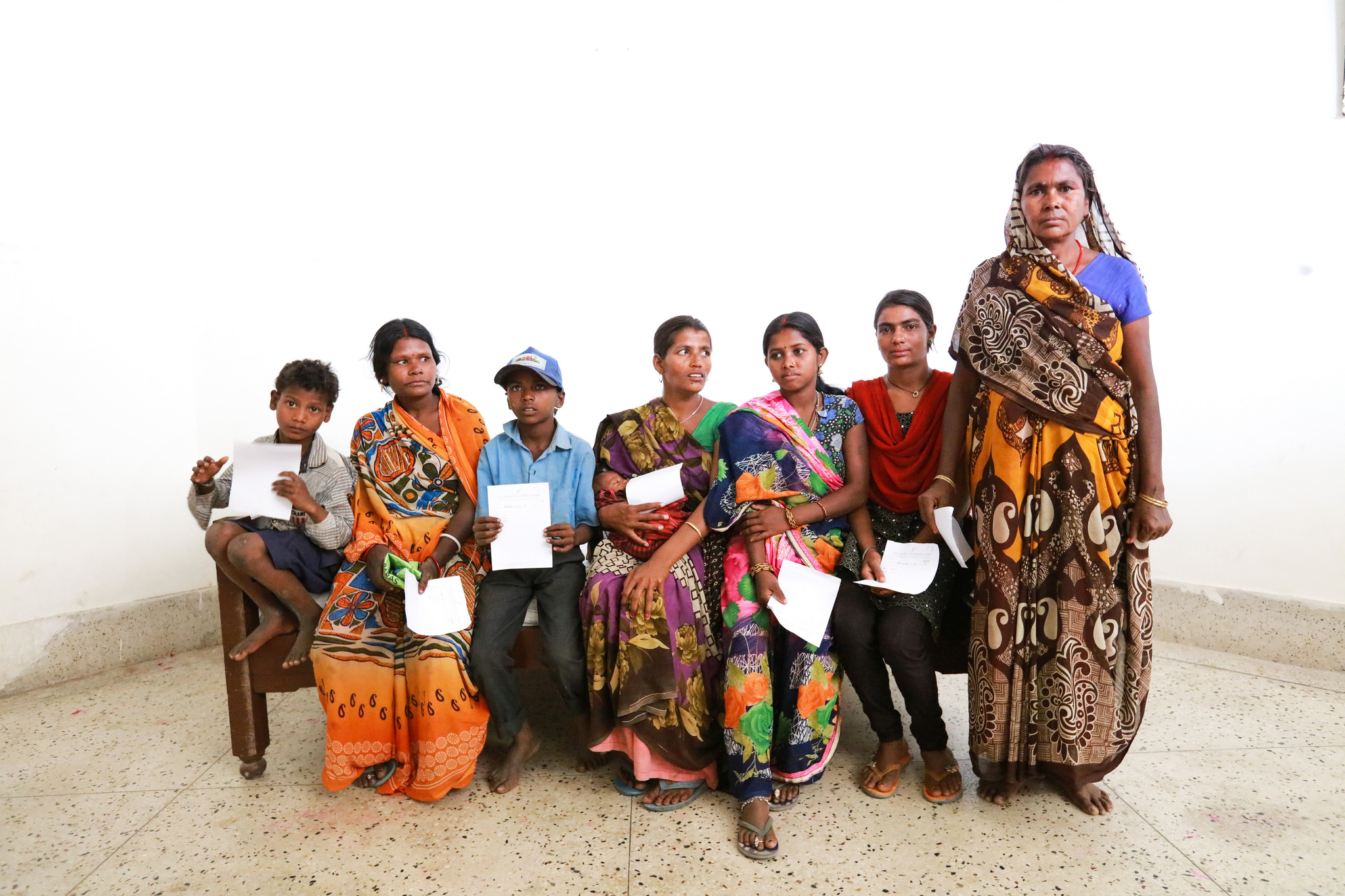
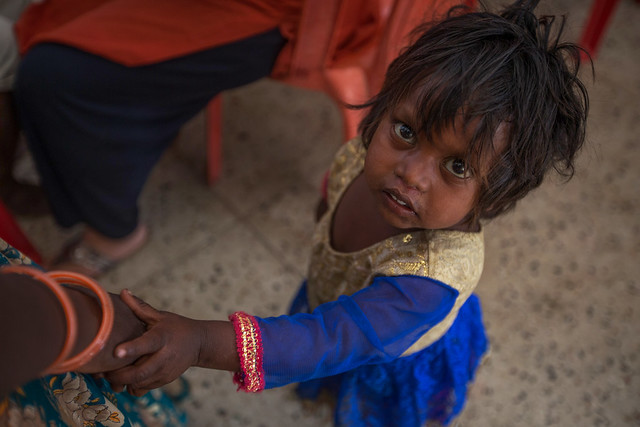
The Kagyu Monlam Well-Being Free Medical Camp is running from February 28 to March 4, in the Bihar Tourism's Sujata Vihar Tourist Complex, in a quiet lane behind the Siddhartha Restaurant in the centre of Bodhgaya. The Medical Camp is reaching out especially to the poorest people of Bihar, by organising a shuttle service with two buses running continuously every day to bring them from outlying villages to Bodhgaya. This gives an opportunity to those who would otherwise not be able to afford the transportation costs to benefit from basic medical care. The Medical Camp is opposite Rokpa’s Akong Tulku Rinpoche Memorial Soup Kitchen, so the villagers can also take advantage of the free, nutritious meal on offer there.
Both these facilities were visited by Gyaltsap Rinpoche and Yongey Mingyur Rinpoche on February 28.
An offshoot of the Medical Camp behind the Kagyu Monlam Pavilion is, at the same time, offering free Tibetan Medicine consultations and prescriptions to Monlam participants. Sangha, yogis and lay practitioners have all been using the service.
The main Medical Camp in Bodhgaya had until this year been run as a collaboration with other organisations, but in 2018, for the first time, it is entirely a Kagyu Monlam initiative. The patients are overwhelmingly women with children. Lhakpa Tsering, who is in charge of the Medical Camp, estimates that they are seeing around 300-400 patients a day. That is half the number of previous years, but he guesses that the warm weather may be having an impact. The procedure is simple enough: people line up for registration, after which they are sent to the assessment desk, where nurses measure their vitals such as weight, height, and blood pressure - even carrying out simple blood tests to check blood sugar levels - and determine what kind of doctor or treatment they need. They may be given a prescription, which is filled out in the Medical Camp itself.
Tenzin Donga, one of the volunteers in the dispensary, enumerates the typical handouts: multivitamins, calcium supplements, protein powder, antibiotics, analgesics, aspirin for cardiac issues, antifungals, antihistamines, cough syrup, blood sugar medicine, folic acid for pregnancy, iron capsules for low haemoglobin.
But more important than the medicines, Lhakpa Tsering stresses, is the counselling that patients receive from nurses and consultants at every stage of the process. And it is brilliantly efficient too: even a long line of colourful saris can be processed in little less than one hour. Dr Shalu Gupta, a trainee doctor from Magadh Medical College in Gaya, and Akila, a young research scholar from Gangtok currently studying in Delhi, point out that they rarely see serious problems. The typical ailments include dermatitis, anaemia, fevers, coughs, colds, asthma, and menstrual problems.
Meanwhile, in the Tibetan Medicine Camp behind the Monlam Pavilion, the most common complaints range from arthritis and gastric problems in the elderly, to allergies, colds, and diarrhoea in the young, and in Westerners, in particular, problems with depression. This camp has also been running for a number of years. Dr Mrs Kalchoe Qusar, who together with her husband, also a Tibetan doctor, run the Qusar Tibetan Healing Centre in Norbulingka in Dharamshala, was asked by the Karmapa to join, and has been coming for over four years.
Medical emergencies are treated with acupuncture, but after a normal consultation, which involves for instance checking the patient's pulse, urine, tongue, and eye colour, the normal prescription is for herbal medicines, all natural, all made in Dharamshala, and containing tantric blessings which are healing for the mind too. The most spectacular thing about the Tibetan Medical Camp, Dr Mrs Qusar says, is how quickly and completely the patients are healed, and she attributes this to the blessings from the Karmapa.